Recycling and Sustainability — Gardening Services Fulham
 Gardening Services Fulham is committed to creating an eco-friendly waste disposal area in every garden we manage. Our sustainable rubbish gardening area approach means we design on-site sorting, reuse and recycling routes so green waste is diverted from landfill. We work within the boroughs' recycling frameworks and adopt best practice from neighbouring councils, aligning our services with local separation schemes to make garden waste disposal as efficient and responsible as possible.
We set measurable goals for our eco garden waste disposal in Fulham, including a public recycling percentage target that drives operational decisions: we aim to recycle 75% of all garden and green waste, and to divert at least 85% of recyclable material away from landfill. To reach this, our teams use pre-sorted sacks, labelled bins and simple on-site separation so glass, metal, plastics and card are removed before composting or chipping starts.
 Many London boroughs, including Hammersmith & Fulham, emphasise source separation: recyclable packaging, paper and card are separated from food and garden waste, while some areas provide specific green bins for garden waste collections. We complement these schemes with our own sorting protocols, ensuring organic pruning and lawn cuttings are composted or converted into mulch while clean timber and inert materials are processed separately.
We also build partnerships with local transfer stations to keep journeys short and carbon impact low. Rather than long-haul trips to distant facilities, our teams use transfer stations that serve Fulham and neighbouring boroughs so green waste, wood chippings and recyclable materials are consolidated and sent to the correct processing facility quickly. This reduces handling time and keeps the sustainable rubbish gardening area network efficient and local.
 Charity partnerships form a key part of our reuse strategy. We work with community groups and local charities to repurpose plants, tools and soil where possible. Items that are reusable but no longer wanted by residents are offered to charities; healthy plants and shrubs find new homes; and reclaimed timber is repurposed for planters and raised beds. Examples of collaboration include:
- Supplying potted plants and seedlings to community gardens and charities
- Donating usable tools and garden furniture to local reuse centres
- Providing compost and mulch to allotments and social enterprise gardens
These initiatives reduce waste, support the local community and strengthen the circular economy around Fulham green spaces.
Our operational model places low-carbon vans and careful route planning at its core. We operate a fleet of hybrid and fully electric vans for shorter urban rounds and low-emission zones, and use low-emission Euro 6 or better vehicles when diesel is required. By prioritising electric vehicles on inner-city jobs we significantly cut transport emissions associated with garden waste removal and make our eco-friendly waste disposal area genuinely low carbon.
 Training is essential: crews are trained in on-site segregation so recyclable containers (glass, metal, plastic, paper/card) are separated from organic material before it leaves the property. Source segregation reduces contamination, improves recycling rates and allows transferred materials to be processed at specialist facilities rather than being rejected and sent to landfill.
 We monitor progress with regular audits and transparent reporting. Each job generates simple metrics — tonnage of green waste collected, volume reused or donated, and percentage recycled — that feed into our sustainability dashboard. Our current corporate target is to reach and sustain a 75% recycling rate for garden waste within two years, alongside an 85% diversion rate of recyclable material from residual streams. Progress is published internally and informs continuous improvement.
Creating a Low-Impact Garden Waste System
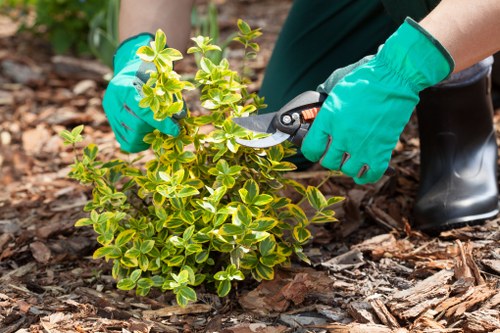
Creating a low-impact, sustainable rubbish gardening area involves practical steps on every job: pre-visit advice on separation, using reusable sacks for green cuttings, chipping branches on-site where appropriate, and ensuring clean timber and soil are processed separately. Our approach emphasises minimal transport, maximal local processing and strong links to borough recycling systems.
Why this matters for Fulham
Local recycling matters. When garden waste is managed correctly it becomes a resource: compost for beds, mulch for soil health and reclaimed timber for community projects. By combining local transfer station access, partnerships with charities, and a fleet of low-carbon vans, Gardening Services Fulham provides a reliable, traceable service that supports borough waste separation policies and delivers a practical, sustainable alternative to landfill.
Our promise: reduce emissions, maximise recycling, and ensure that your garden contributes to a greener Fulham. We continually refine routes, strengthen charity partnerships and track our recycling percentage target so each season becomes more sustainable than the last.